_edited.png)
Gutter Cleaning Services: What They Actually Cover and Why It Matters
.svg)
Professional gutter cleaning services involve the inspection, clearance, and flush-through of your building's guttering system — not just removing autumn leaves. A qualified team removes compacted debris, checks for joint failures, sagging sections, and blockages in downpipes, then tests the whole system flows correctly before leaving the site.
Key takeaways
Gutter cleaning services cover far more than leaf removal: debris compaction, moss growth, joint separation, and blocked downpipes are the routine findings that cause real structural damage if missed.
Blocked gutters direct water behind fascias and into soffits, which can trigger damp penetration into walls and ceilings — a repair bill that dwarfs the cost of a routine clean.
Commercial properties typically require specialist equipment such as vacuum systems and camera inspection tools; our existing article on What Equipment Do Professional Gutter Cleaners Use for Multi-Storey Commercial Buildings in the UK? covers that in detail.
Timing matters: a clean after the last leaf fall of the year (typically November to December in Oxfordshire and the surrounding counties) is the most efficient single annual visit, though properties near mature trees or flat-roofed sections may need two.
Aston Maintenance covers Oxfordshire, Buckinghamshire, London, Warwickshire, and Northamptonshire for both commercial and residential gutter cleaning.
What do professional gutter cleaning services actually include?
A professional gutter cleaning service is a systematic process, not a quick sweep. The technician clears debris from the guttering channels, flushes the system with water to test flow and identify blockages, inspects joints and brackets for signs of failure, and checks downpipes are clear all the way to the drain outlet. Any blockage or defect found is flagged before the visit ends.
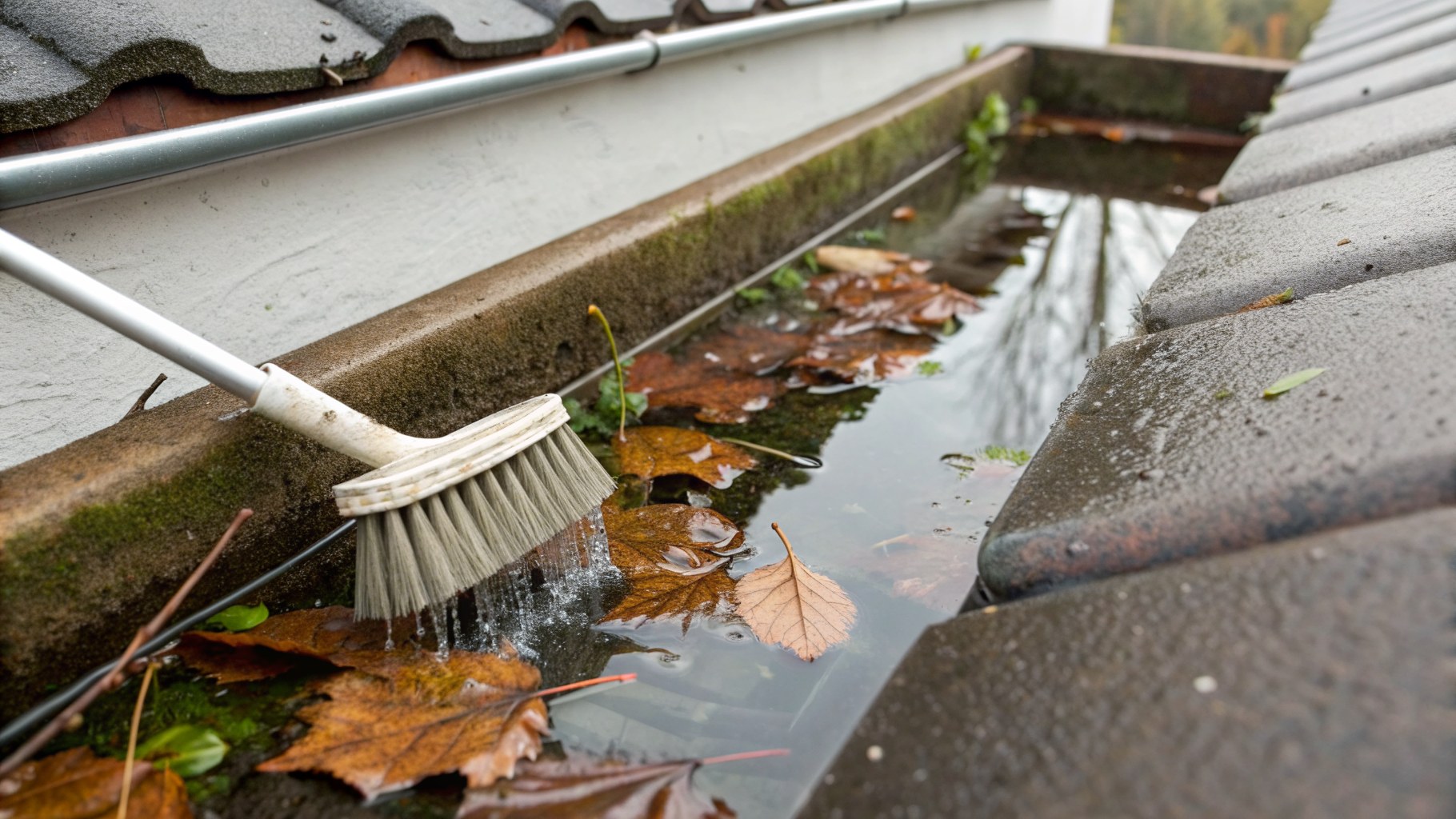
The debris that causes the most damage is rarely the loose autumn leaves you can see from the ground. It is the compacted layer of decomposed leaf matter, silt, moss, and seed growth that lines the base of the gutter channel after several seasons without attention. That layer holds moisture against the gutter material and accelerates corrosion or joint failure in uPVC and aluminium systems alike.
Why does gutter cleaning matter more than most small business owners realise?
Gutters fail quietly. By the time a leak is visible inside a building — a damp patch on a ceiling, staining on an internal wall — water has usually been tracking behind the fascia for months. For a small business operating from commercial premises, that means potential damage to stock, equipment, or the fabric of the building itself.
The mechanism is straightforward: a blocked gutter cannot carry rainwater away from the roofline. Water backs up, overflows behind the fascia board, saturates the soffit, and eventually finds a path into the wall cavity or ceiling void. The repair is considerably more disruptive and expensive than the gutter clean that would have prevented it.
Fascia and soffit condition is closely tied to gutter health — which is why Aston Maintenance includes fascia inspection as part of its gutter cleaning visits. A compromised fascia that goes unnoticed during a gutter clean is a missed opportunity to act before rot sets in.
Gutter cleaning vs a DIY clear-out: what is the practical difference?
Approach | What it typically covers | Key limitation |
DIY ladder and trowel | Surface leaf removal from reachable sections | Cannot inspect joints, flush downpipes, or safely reach multi-storey guttering |
Professional vacuum system | Full channel clearance, downpipe flush, joint inspection | Requires booking; small upfront cost |
Professional with camera inspection | All of the above, plus internal downpipe and underground drain check | Higher cost; suited to complex commercial systems |
The honest case for DIY is narrow: single-storey residential properties with simple guttering, an owner confident on a ladder, and a genuinely low debris load. For most commercial premises — even a modest two-storey unit — the safety case alone justifies a professional service. Working at height regulations in the UK place real obligations on business owners who ask employees to use ladders beyond a brief, low-risk task.
When should a small business book a gutter clean, and how often?
For most commercial properties in Oxfordshire and the surrounding counties, one thorough clean per year is a reasonable baseline. The best timing is late November or early December, after deciduous trees have finished dropping leaves but before prolonged winter rain arrives to push debris into downpipes and drains.
Properties with overhanging mature trees, flat roof sections with internal drainage, or guttering that runs beneath parapet walls typically accumulate debris faster. Two visits per year — spring and autumn — is appropriate for these buildings. Our article on When Should You Clean Your Gutters? sets out the timing criteria in full, so this page will not repeat that ground.
The decision rule is simple: if your guttering has not been inspected and flushed in the last twelve months, book a service before the next sustained rainfall. Acting after a blockage has caused an overflow costs more than acting before.
Frequently Asked Questions
Does a gutter cleaning service include repairs, or only clearance? Most professional gutter cleaning visits focus on clearance, inspection, and reporting. Minor issues — a loose bracket, a small joint seal — may be rectified on the day, but structural gutter repairs or fascia replacement are typically quoted separately. Ask your provider what is included before booking.
Can blocked gutters affect my building insurance claim? Yes, in some cases. Insurers can decline or reduce claims for damp or water ingress if they determine the damage resulted from a lack of maintenance. Keeping a record of regular professional gutter cleans demonstrates reasonable upkeep, which is relevant if a claim is ever disputed.
How long does a gutter cleaning visit take for a typical commercial property? For a standard single-storey commercial unit, a thorough clean and flush typically takes between one and two hours. Larger or more complex buildings — multi-storey premises, properties with internal downpipes, or sites with significant debris accumulation — will take longer, and a professional provider should survey the site before quoting a fixed time.
Is gutter cleaning disruptive to a business operating on the premises? It is generally low disruption. Technicians work externally at roofline level; there is no need to clear internal spaces or interrupt normal operations. The main practical consideration is access to the building perimeter for ladders or equipment.
Do gutters on flat-roofed commercial buildings need a different type of service? Flat roofs often have internal outlets and drainage channels rather than conventional guttering, which can block with silt and moss differently from pitched-roof systems. These outlets require clearing to the same standard — and blocked internal drainage on a flat roof carries a higher risk of ponding water and structural loading than a blocked conventional gutter.
Written by the Aston Maintenance team — a family-run property maintenance business with over 25 years of experience serving commercial and residential clients across Oxfordshire, Buckinghamshire, London, Warwickshire, and Northamptonshire.
Last updated: 9 October 2026


Comments