_edited.png)
What Does a Gutter Cleaning Company Actually Do on the Day?
.svg)
Last updated: 13 October 2026
When an eavestrough cleaning company arrives at your property, they do considerably more than scoop out a few leaves and leave. A professional visit covers a structured sequence of inspection, clearance, flushing, and reporting — the entire guttering system, from fascia board to drain outlet, checked and cleared in one visit.
Key takeaways
A professional eavestrough cleaning visit typically covers four distinct stages: arrival assessment, debris removal, downpipe flushing, and a final flow test before the team leaves.
Debris is removed by hand or with a high-reach vacuum system, not simply pushed along the gutter run — pushing compresses blockages further into downpipes.
Every downpipe is tested individually, because a clear gutter channel feeding a blocked downpipe still causes overflow and water ingress.
The team documents visible defects — cracked joints, sagging sections, missing brackets — so you have a written record before any repair quote is discussed.
For multi-storey commercial buildings, access equipment (scaffolding, cherry picker, or high-reach vacuum) is selected in advance; the crew arrives with that equipment already chosen and booked.
Aston Maintenance carries out gutter cleaning across Oxfordshire, Buckinghamshire, London, Warwickshire, and Northamptonshire for both commercial and residential properties.
What happens before the crew even touches the gutters?
The first ten minutes of any professional eavestrough cleaning visit are spent on a site assessment, not cleaning. The crew walks the perimeter of the building to identify every gutter run, every downpipe outlet, and any visible problem — overflowing sections, plant growth, detached brackets, or standing water staining on the fascia boards.
This walk-round shapes the entire job. A section with a heavy moss or soil build-up needs different handling from a run clogged only with leaf matter. A downpipe that discharges into an underground drain rather than a surface gulley requires a different flushing approach. Getting this wrong at the start means discovering the problem at the end, when it is too late to correct without extending the visit.
The team also confirms access at this stage. Working at height requires a stable, safe platform — whether that is a ladder, a high-reach vacuum system from ground level, or a cherry picker for a taller commercial building. Access is not improvised on arrival; a professional crew arrives with the right equipment already loaded, but the walk-round confirms the plan is workable for the specific site conditions on the day.
How does the crew remove debris from the gutters?
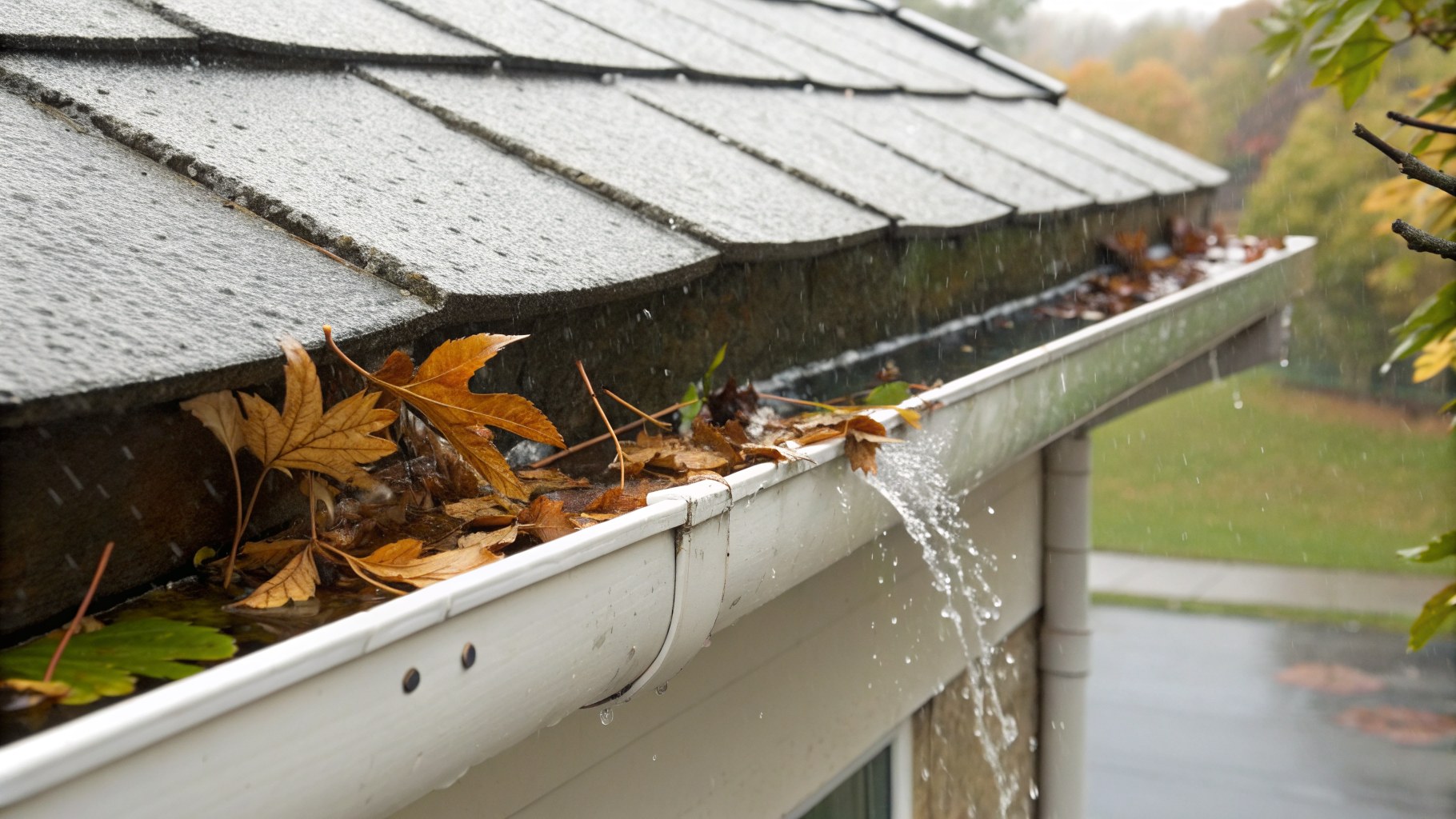
Debris removal is the core task, and the method matters. Professional crews remove debris from the gutter channel by hand (using scoop tools) or by suction (using a high-reach wet-and-dry vacuum system with a curved attachment). Both methods extract the material rather than pushing it towards the downpipe outlet.
Pushing debris along the gutter run towards the downpipe is a common shortcut that creates a secondary blockage inside the downpipe itself — often tighter and harder to clear than the original channel blockage. A professional team works from one end of the run to the other, lifting material out and bagging it as they go.
For ground-level access systems, the operator uses a camera attachment or a specialist curved gutter tool on a telescoping pole that reaches up to 12 metres without any ladder work. This approach is increasingly common for single-storey and low two-storey buildings because it removes the risk of ladder movement damaging the gutter profile itself — gutters are more brittle than they look, particularly uPVC sections that have been in place for many years.
All removed debris is collected and taken away by the crew. The job site is left clean; debris is not deposited on the roof, the driveway, or adjacent flowerbeds.
What does a downpipe check and flush actually involve?
Once the gutter channels are clear, every downpipe is tested individually. A downpipe can appear clear at the top opening while carrying a compacted blockage half a metre down — leaves, silt, and moss mat together into a plug that water cannot shift on its own.
The crew introduces water from the top of each downpipe and watches for three things: the speed at which water passes through, any backing-up at the top, and whether the water emerges cleanly at the outlet. A slow drain indicates a partial blockage; water backing up immediately signals a full blockage; discolouration at the outlet confirms that debris has been flushed clear.
Where a blockage is found, the crew uses a drain rod, a pressure lance, or a specialist unblocking tool depending on the pipe diameter and the nature of the blockage. If the downpipe connects to an underground drain, the crew checks that the connection point is clear and that water is flowing into the drain rather than pooling around the outlet.
This downpipe stage is where a professional visit earns its cost. A clear gutter channel that feeds a blocked downpipe gives you the same overflow problem as a blocked gutter — water backs up, spills over the fascia, and tracks down the external wall.
How does the crew check for damage while they are on site?
Professional eavestrough cleaning crews inspect for physical defects during the same visit, because they are already at the right vantage point to see problems that are invisible from ground level. The inspection covers:
Gutter joints and unions — failed sealant, cracked plastic, or corroded metal at the joints between sections
Brackets and fixings — missing, bent, or detached brackets that allow the gutter to sag, which disrupts the fall towards the downpipe
Fascia boards — rot or damp staining behind the gutter, which can indicate the gutter has been overflowing for some time
End caps and stopends — cracked or missing caps at the end of runs allow water to escape directly down the wall
Downpipe clips and brackets — loose clips allow the pipe to pull away from the wall, opening gaps where water escapes before reaching the outlet
The crew records every defect found. This is not a sales exercise — it is a site record. You receive a written note (or a photograph log, depending on the company) of what was found, where it is, and how serious it appears. You can then decide whether to address the repair immediately, schedule it, or get a second opinion.
Aston Maintenance, for example, operates as a property maintenance business, not just a cleaning contractor, so the same team that cleans can often flag whether a repair falls within their scope or whether it needs a specialist roofer or joinery contractor.
What is the final flow test, and why does it matter?
Before leaving the site, a professional crew runs a final flow test: water is introduced at the highest point of each gutter run and the team confirms it reaches the downpipe outlet at the correct speed, with no pooling, no overflow, and no leakage at any joint along the run.
This test replicates what happens during a heavy rainfall event. A gutter that drains slowly under a trickle of test water will back up and overflow during a sustained downpour. The flow test catches partial blockages and inadequate fall (the slight downward angle built into the gutter run) that are not obvious during the clearing stage.
If the test reveals a problem — a joint weeping, a section that has lost its fall, a downpipe outlet still running slow — the crew addresses it before closing out the visit. This is the professional standard that distinguishes a thorough eavestrough cleaning company from a fast-in, fast-out operation.
How long does a professional gutter clean take for a commercial property?
Duration depends on the size of the building, the number of gutter runs and downpipes, the volume of debris, and the access method required. As a practical guide:
Property type | Typical gutter runs | Estimated duration | Access method likely |
Single-storey retail unit | 2–4 runs | 1–2 hours | High-reach vacuum or ladder |
Two-storey office building | 4–8 runs | 2–3 hours | Ladder or high-reach vacuum |
Three-storey commercial block | 6–12 runs | 3–5 hours | Cherry picker or scaffolding |
Industrial unit with box gutters | Variable | Half day or more | Cherry picker or MEWP |
These are illustrative durations only — actual time varies with access, debris volume, and the number of downpipes. A heavily silted gutter run on a building that has not been cleaned for several years takes substantially longer than an annual maintenance visit on a regularly serviced property.
For small business owners managing a commercial premises, understanding duration matters for scheduling: parking arrangements, staff access, and any deliveries that cannot be blocked by a cherry picker or a crew vehicle need to be planned around the visit window.
What should you expect the crew to hand over when the job is finished?
A professional eavestrough cleaning company does not simply pack up and drive away. The handover at the end of the visit should include:
A verbal summary of what was found and what was cleared, so you understand the condition of the system.
A written job sheet or digital report noting defects found, downpipes tested, and any areas that could not be fully accessed.
Photographs of significant defects, particularly any that will require a follow-up repair.
A clear note of any sections that were not cleaned — for example, a downpipe buried in a void that could not be safely rodded — and the reason.
A recommendation on the next cleaning interval based on the debris volume found, the surrounding tree cover, and the property type.
That final point is worth emphasis. The cleaning interval for a commercial property surrounded by mature trees in a heavy-leaf area is different from an open-plan industrial estate. A crew that has just worked through your specific gutter system is better placed than anyone to give you a grounded recommendation.
Frequently Asked Questions
What is an eavestrough cleaning company and what does it actually do? An eavestrough cleaning company (also called a gutter cleaning company in the UK) clears debris from the guttering channels around a building, flushes and tests downpipes, inspects for physical damage, and confirms the whole drainage system flows correctly before leaving. A professional visit covers the full system — not just the visible channel — and includes a written record of any defects found.
How do gutter cleaning crews access gutters on tall commercial buildings? For buildings above two storeys, crews typically use a cherry picker (Mobile Elevated Work Platform), scaffolding, or a telescoping high-reach vacuum system. The access method is confirmed during the booking process based on the building height and site layout. For more detail on access options for multi-storey buildings, Aston Maintenance's guide on equipment used for multi-storey commercial gutter cleaning covers the trade-offs between each method.
Does a gutter cleaning company remove the debris from site? A professional crew bags and removes all debris as part of the service. Material is not left on the roof, in flowerbeds, or on the driveway. If a large volume of debris is expected — for example, a building that has not been cleaned for several years — confirm the disposal arrangement in advance, but removal is standard practice.
Can a gutter cleaning company repair damaged sections on the same day? Minor repairs — replacing an end cap, resealing a joint, re-fixing a loose bracket — can often be carried out on the same visit if the crew carries the relevant parts and the repair is straightforward. Structural repairs, fascia replacement, or significant sections of new guttering are separate jobs that need scheduling. The crew's job sheet will clearly distinguish between cleaning tasks completed and repairs recommended.
How often should a commercial property have its gutters cleaned? Most commercial properties benefit from a clean twice a year — typically in late autumn after leaf fall and again in late spring after the pollen and seed season. Properties with heavy tree cover, flat roofs with box gutters, or buildings in areas prone to moss growth may need quarterly attention. The best guide is the debris volume found during a first professional visit, which will reflect the actual conditions at that specific site.
Will the crew let me know if there is a serious problem with the guttering? Yes. A professional team provides a written record of every defect observed during the visit. This is not a pressure-sales mechanism — it is a site record that protects you as the property owner or manager. Knowing that a particular joint is failing before the winter gives you the option to plan and budget a repair, rather than dealing with a water ingress problem after the fact.
Is gutter cleaning disruptive to a business operating on site? For most commercial properties, gutter cleaning causes minimal disruption. The crew works externally and does not need to access occupied areas. The main practical consideration is vehicle and cherry picker parking, which may temporarily restrict part of a car park or pavement. Agreeing the access plan in advance — particularly for town-centre premises or sites with active loading bays — avoids delays on the day.
Aston Maintenance is a family-run property maintenance business with over 25 years of experience, covering Oxfordshire, Buckinghamshire, London, Warwickshire, and Northamptonshire. Services include gutter, fascia, window, solar panel, and patio cleaning for commercial and residential properties.
Last updated: 13 October 2026


Comments